In July 2013, shortly after my elementary school graduation, my family of five shuffled into our early 2000s black Suburban and took a celebratory trip to Moody Gardens in Galveston. I vaguely remember thinking about which middle school I would attend in the fall, a question that was more so the concern of my parents but was typically shoved to the back of my mind.
As the eldest of three children, and the only girl, my favorite activities included doing anything I could outdoors – skateboarding, playing tennis – and learning new instruments like the guitar. Having two younger brothers taught me early what it meant to act as a role model, even if my competitive nature sometimes put us at odds.
My parents were both practicing physicians at the time, so a family trip required not only coordination between their schedules, but cooperation between myself and my brothers. It was often that I would see them preoccupied, but my mother received a call that elicited a different reaction – surprise, then uncertainty, and somehow ending pleasant, almost reassured.
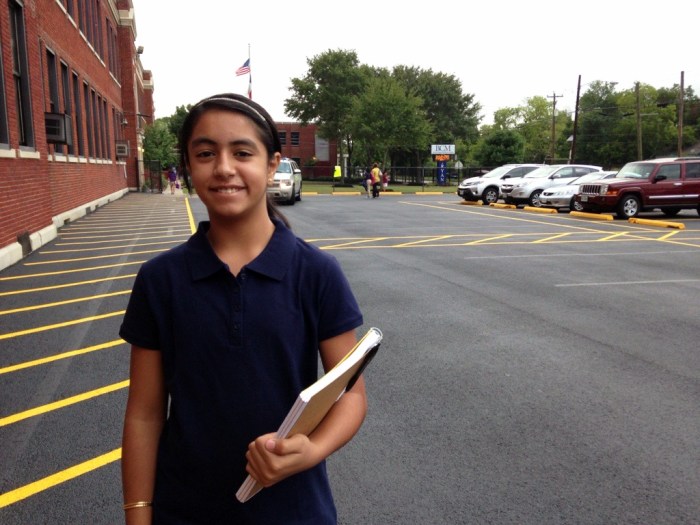
The caller, Dr. Jyoti Malhan, then-incoming principal of the newly established Baylor College of Medicine Academy at James D. Ryan Middle School, asked for an update on my intent to join the inaugural class. My mom expressed our collective interest in the school’s STEM mission but that she and my father had already begun planning my attendance at other schools.
Malhan invited us for a private tour of the school before it opened. Of course, the last thing on my mind was leaving a vacation to return to Houston early so I could visit a school, but nonetheless the trip ended. We arrived at the freshly-painted, red double-doors of the school the following Monday.
We met in the library, and Malhan began by painting her vision. A bioscience and health professions-focused middle school that would be tailored toward students of all backgrounds and would offer a rigorous curriculum typically found at the high school / early college level. She spoke with a passion and vigor I hadn’t seen before. But what struck me was her confidence that I would be the perfect candidate for the school. She asked my goals for the future and made me believe that with her mentorship and the faculty she had appointed, that future wasn’t only possible, it was a certainty.
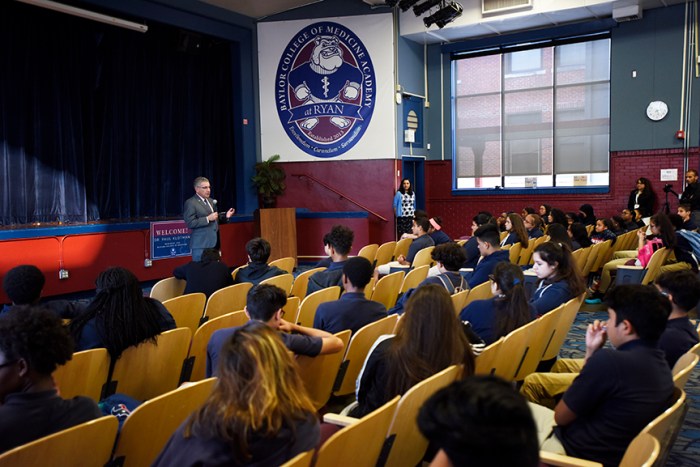
Before I knew it, I was in a packed auditorium on the first day of school, wearing a blue polo and khakis that were freshly ironed, meeting my classmates for the first time. At the front of the room was Dr. Paul Klotman, president, CEO and executive dean of Baylor College of Medicine; Dr. Nancy Moreno, professor and chair of the Huffington Department of Education, Innovation and Technology, and other prominent Baylor faculty.
They spoke of the importance of our inaugural class, what we represent as future healthcare professionals in training and how the habits we would build there would push us as far as we could imagine – if we work hard. I was left not only inspired but with a responsibility to be better – not just for myself but for my peers and for the future of healthcare education and practice.
Sixth and seventh grades pulled me into a whirlwind of discovery. Immersed in classes like neuroscience, scientific decision-making and anatomy, I performed dissections and learned how connected each system of the human body was; it fascinated me. These experiences made me feel privileged to learn in a place that centered scientific exploration and biological discovery.
At the same time, I often felt out of place and unsure if I could fit into the demanding environment of the school. With new teachers, an unfamiliar curriculum and classmates from a wide range of cultural, social and academic backgrounds, everything was new to all of us. Each of us was trying to excel academically while still figuring out where we fit, how to build friendships and how to stay true to ourselves in a setting that expected so much from us.
Our teachers learned alongside us. Many were teaching a healthcare-focused curriculum for the first time, adapting lessons to a group of students who started with more differences than similarities. The school’s strong focus on academics also meant stepping away from many traditional after-school activities, and the transition was harder than I expected.
Things began to settle in seventh grade. My class had survived the uncertainty of its first year and grown stronger for it. I started to find new outlets like speech and debate and wrestling, which grounded me in community and pushed me to discover a different kind of strength, both mental and physical.
Through all of middle school, Malhan was a consistent anchor. When my grades slipped or my confidence wavered, she would call me into her office for a talk. I instinctively braced for a lecture that never came. Instead, she asked questions, listened without judgment and helped me untangle what I was feeling before offering gentle, but honest, feedback. She returned to the same message, a refrain that still guides me today: she knew I could do more but reminded me that none of that would matter until I chose to believe in myself, too.
In eighth grade, I became more social with my peers and slowly built a tool box of activities, mentors and habits that made BCM Academy at Ryan feel like a home away from home. I realized that my motivation no longer came from feeling “forced” to study independently, but from collaborating with classmates, learning from teachers and hearing about their own life journeys.
Algebra, however, was a persistent challenge. My teacher, Mr. Brian Wanjala, noticed how hard I worked in class and homeroom and offered to coach me after school. Those sessions included equations and practice problems, but what helped me most was his willingness to show up and listen to my worries about high school and the future.
Where Malhan often challenged me to see the bigger picture of who I could become, Wanjala met me in the day-to-day work of getting there. In his classroom and after-school sessions, growth looked less like a grand breakthrough and more like staying late, rewriting problems and being reminded that progress – not perfection – was the goal.
As high school applications neared, I found myself visiting with Malhan more frequently. I asked where she thought I should go, convinced that I should simply attend the high school I was zoned to in Houston ISD. She challenged me to think back to the goals we first discussed in that quiet library three years earlier: to make people feel equal, seen and supported. And she reminded me that I was just as deserving of those things as the people I hoped to advocate for in my future career.
Malhan asked if I would join her that weekend to speak with incoming students and families about BCM Academy at Ryan. I served as a lead student representative for the school. As curious parents and anxious fifth graders began flooding the halls of the school, I told them about the flagship curriculum and its promise that had directly impacted the student and young adult I was becoming.
I saw in their worried eyes a reflection of the uncertainty I’d carried into those red double-doors just a few years earlier. My words reached families hoping their children could find a place to be both challenged and accepted. With every conversation, I felt the weight of how much I’d grown. I wasn’t just preparing for high school; I was passing the hope and foundation that BCM Academy at Ryan had built within me.
Within a few weeks, the email finally came.
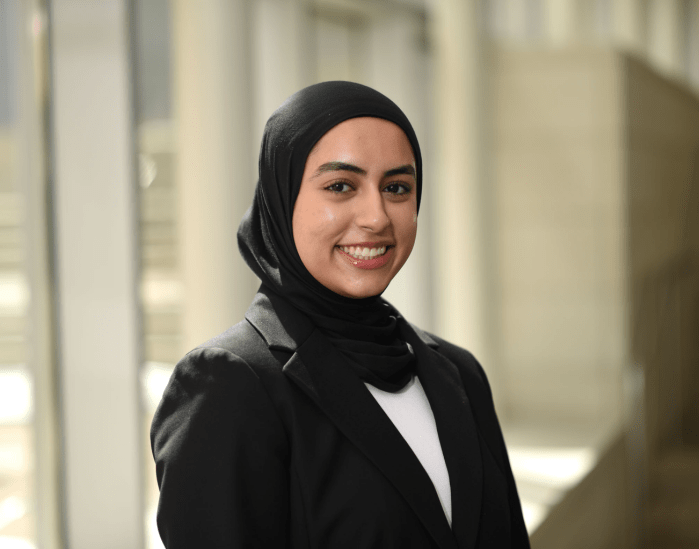
“Congratulations! You have matched into the DeBakey High School for Health Professions as a member of the Class of 2020.” My eyes immediately welled up, and my jaw dropped. In that moment, I could trace a straight line from that first phone call in Galveston to long afternoons in Wanjala’s classroom to precious interactions with students and families I met through Malhan’s encouragement.
I stepped toward DeBakey High School carrying knowledge and confidence, realizing that the belief others had in me finally became a belief I could hold for myself.
Story by Mariam Kundi, administrative fellow in the Office of the President at Baylor College of Medicine. Kundi holds a bachelor’s degree in kinesiology and a master’s degree in business, both from Texas A&M University. She was part of the inaugural class at Baylor College of Medicine Academy at Ryan in Houston’s Third Ward.
Baylor College of Medicine’s Administrative Fellowship Program cultivates new talent in healthcare management through observation, exchange and hands-on experience.
Read more


 BCM Family