When Lorrie Hill saw patients during her pediatric hospital medicine rotation at Texas Children’s Hospital, she understood their experience on a personal level. Hill, now a third-year student in the Physician Assistant Program in the School of Health Professions, had been a patient at the same hospital since the day she was born with a congenital heart defect.
Throughout her childhood and early adulthood, she spent countless weeks in the Texas Children’s Cardiology Patient Care Unit (CPCU). Those admissions and clinic visits fed her love for medicine and inspired her to pursue a career in healthcare.

“Texas Children’s has such a welcoming atmosphere, and I’ve always been interested in science,” Hill said. “As a kid, I went in with a lens of curiosity rather than a lens of fear.”
By the time she started high school, she had undergone three open heart surgeries. Growing up, her love for medicine continued to grow. “I was that nerdy kid in high school that went to mock medical school summer camp,” she said.
After working as a student athletic trainer in high school, she decided to pursue a pre-physical therapy major in kinesiology at Texas A&M University. Unfortunately, her health took a turn for the worse during her second year of college, putting the brakes on her plan to become a physical therapist (PT).
“My heart failure was getting a lot worse. My cardiologist sat me down and told me I wouldn’t be able to physically handle being a PT,” Hill said.
After graduating in May 2020, she returned to Houston so she could be closer to her care at Texas Children’s while she waited for a heart transplant. She decided to pivot to another area of healthcare and started a Master of Public Health degree in epidemiology.
But her heart continued to deteriorate. In February 2021, she checked into Texas Children’s and was hospitalized for seven weeks before she finally got the call she had been waiting for: a heart was ready for transplantation. It turned out to be a very important hospital stay in more than one way.
“During that stay, I really got to interact with PAs and learn what they did,” Hill said. “After my transplant, I started peppering the PAs with questions before rounds. One of my PAs came back one afternoon and gave me the whole run down of the career. During that hospital stay, I decided I wanted to apply to PA school.”
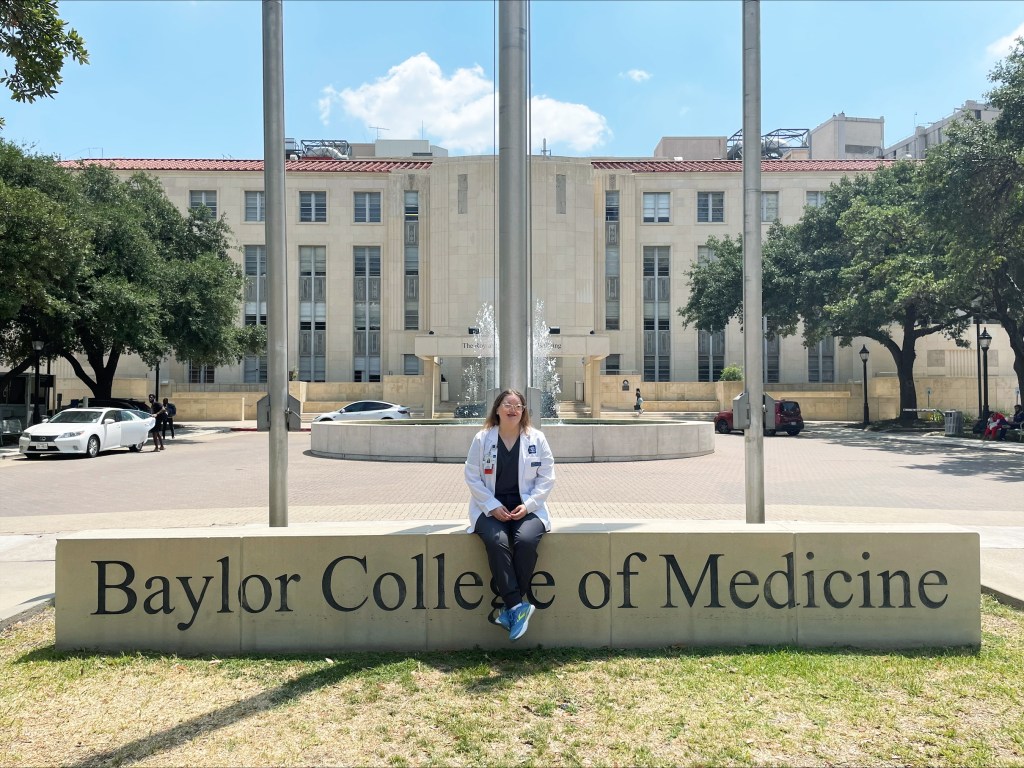
As she regained her health following her transplant, Hill realized it would be possible pursue a career as a PT as she originally planned. She applied to both PA and PT programs and was accepted into both of her top choices. But after an experience shadowing a PT, she realized she did not want to miss the opportunity to practice medicine. She ended up choosing the PA program at Baylor.
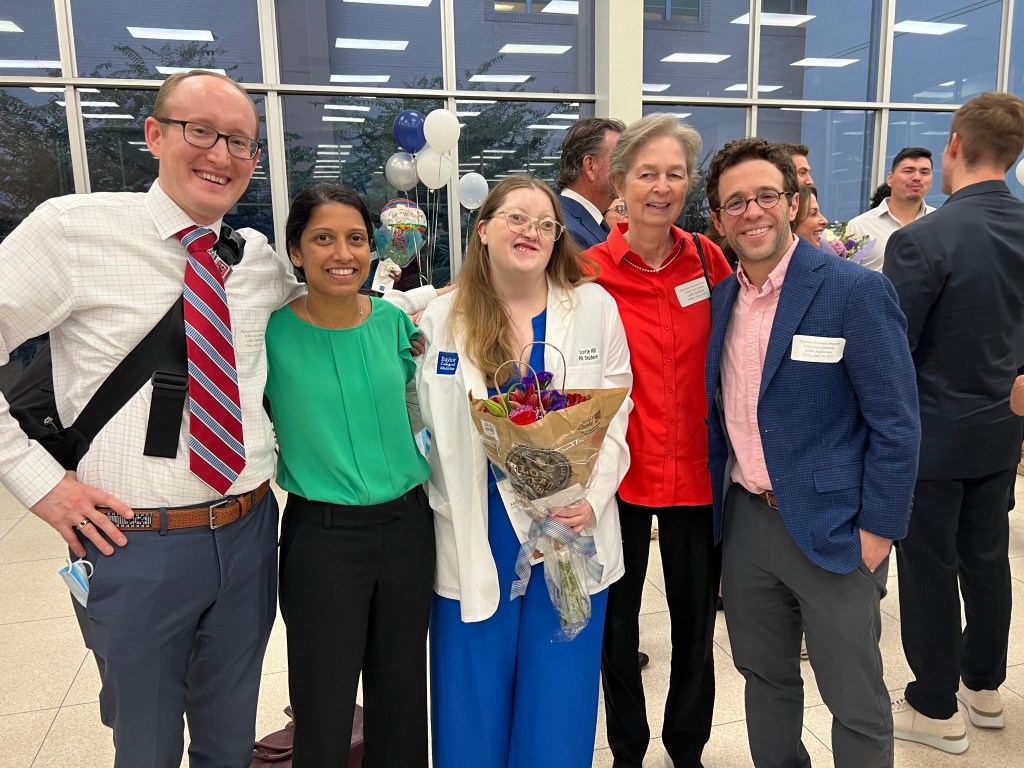
Her care team at Texas Children’s has supported her every step of the way, she said. Her pediatric cardiologist and several doctors on her transplant team attended her Physician Assistant White Coat Ceremony after her first year as a PA student.

In March 2025, Hill began her pediatric hospital medicine rotation at Texas Children’s on the anniversary of her transplant. Although the Heart Center and the CPCU have changed locations over the years, she recognized the familiar halls where she received treatment for so many years as a child.
Now, she feels empowered to be on the other side and see the hospital from a healthcare provider’s perspective. “When I went to the CPCU, where I spent two and a half months during my transplant process, I thought I was going to have an emotional reaction,” Hill said. “But once I stepped into the patient’s room, my game face was on.”
Hill will graduate from the PA Program in December, and she recently accepted a position in the pediatric intensive care unit at Texas Children’s. As she prepares to start her career, she wants to help make the inpatient experience a little less scary for the children she will care for.
“The ICU can be traumatic for kids. You can’t completely take the scariness away,” Hill said. “But I want to strive to make sure that the patient and their parents have a better understanding of what is happening.”
Hill also wants to encourage people with health conditions or disabilities to consider becoming a healthcare provider.
“There’s an added level of empathy baked in when you have been a patient and you understand what your patient is going through,” Hill said. “Approaching patients with empathy is really important.”
By Molly Chiu, communications lead at Baylor College of Medicine
 BCM Family