At Baylor, it takes all kinds of nurses to help fulfill the College’s mission of excellence in patient care, research and education. Every day this week, BCM Family will share a Q-and-A with a nurse who works at Baylor College of Medicine.
Read more about some of these special healthcare professionals, and be sure to wish them and others a Happy Nurses Week this May 6 – 12!
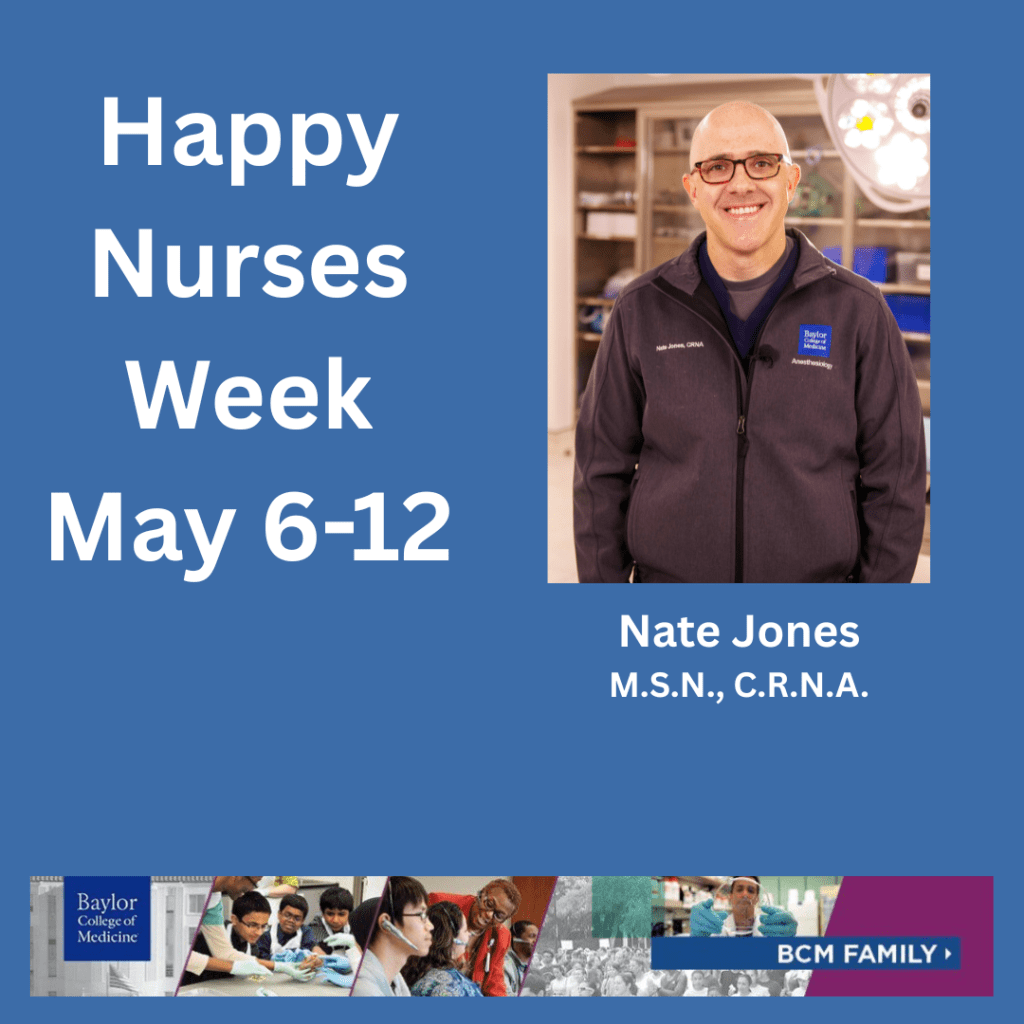
Q: How long have you been working at Baylor College of Medicine?
A: I have been a Certified Registered Nurse Anesthetist (CRNA) at Baylor College of Medicine since 2015. I began my nurse anesthesia career at Texas Children’s Hospital, where I practiced for six years. In 2021, I transitioned to Ben Taub Hospital and, in 2023, became a full-time core faculty member in the DNP-Nurse Anesthesia program in the School of Health Professions.
Q: Describe your role as a nurse anesthetist.
A: I serve in academic and clinical capacities. Eighty percent of my time is devoted to academics, where I teach and advise students. The remaining portion is spent in clinical practice at Ben Taub Hospital, where I provide anesthesia care to a diverse patient population. Balancing both roles keeps me engaged and allows me to bring real-world experience into the classroom.
WATCH: Nate Jones describes his job on Baylor’s YouTube.
Q: At what affiliate do you work, and what has your experience been like there?
A: I have worked at both Texas Children’s Hospital and Ben Taub Hospital, and my experiences at each have been deeply rewarding. Providing anesthesia is fun and fulfilling, and I feel incredibly fortunate to do this job every day. What has made these experiences even more meaningful is the caliber of the people I work with – in anesthesia, perioperative services and the DNP-Nurse Anesthesia Program. These teams are exceptional, and they make the work even better.
Q: What kind of education / training is required for your role?
A: CRNAs are advanced practice registered nurses who undergo rigorous training. Admission to nurse anesthesia programs requires a nursing background and at least one year of critical care experience. All current nurse anesthesia programs confer doctoral degrees, with a typical program length of 36-to-51 months, depending on the university. By graduation, nurse anesthesia students average more than 9,000 hours of clinical experience, preparing them for the high level of responsibility the role demands.
Q: What is the best thing about being a nurse at Baylor College of Medicine?
A: The best part of being a CRNA at Baylor College of Medicine is the people I work with. In both my clinical and academic roles, I’m surrounded by dedicated, skilled professionals who excel in their field. It’s a privilege to be part of such a collaborative and supportive community here at BCM.
By Dana Benson
 BCM Family