Avid marathoner and fitness enthusiast Lucas Crisanti values the freedom of movement.
Regardless of mobility challenges, everyone deserves to experience the freedom that sports and exercise provide, and Crisanti is committed to “going the extra mile” in his professional and personal life to ensure this belief is a reality.
Courtesy of Lucas Crisanti
Crisanti is a graduate of Baylor College of Medicine’s School of Health Professions Orthotics and Prosthetics Program. He now works as a prosthetic clinical specialist and global Running Clinic coach for Ottobock. And he has already made strides in his commitment to serving those with physical differences.
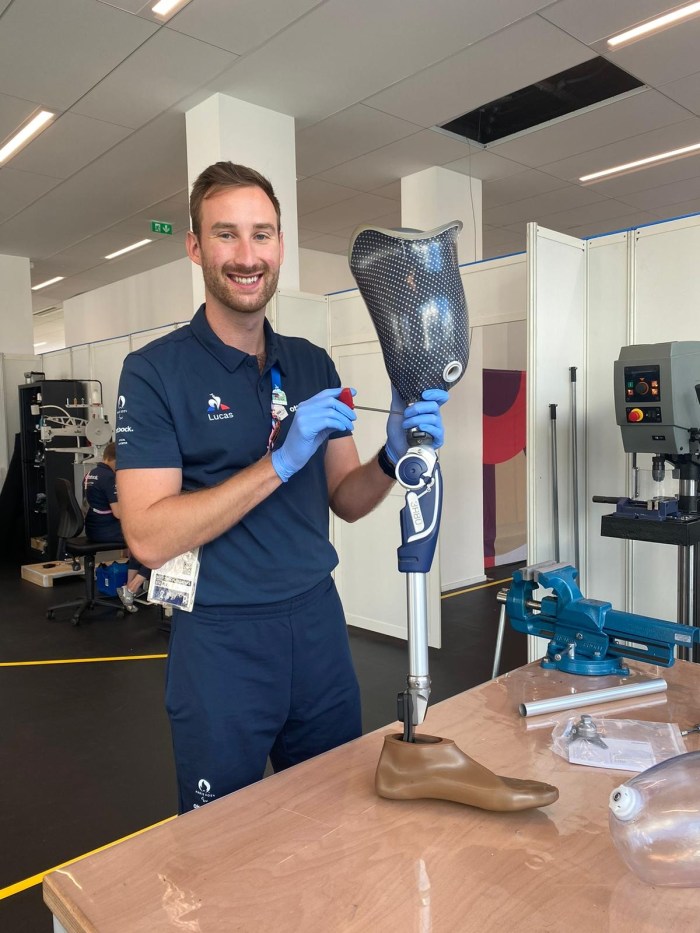
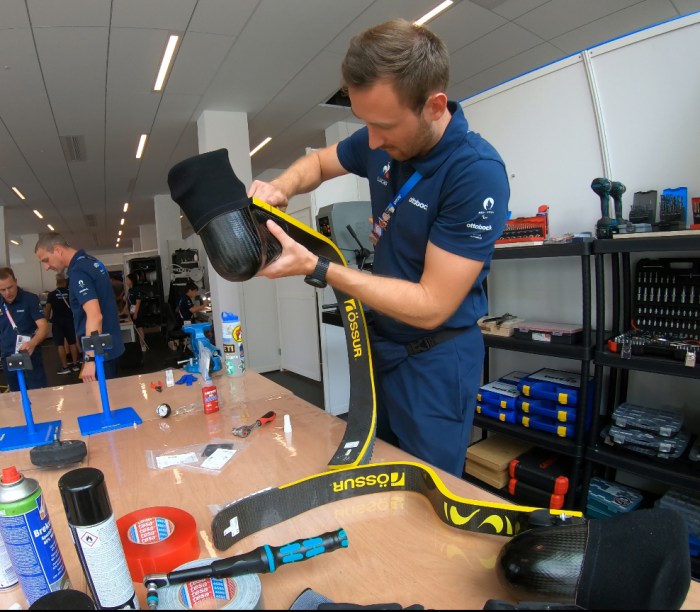
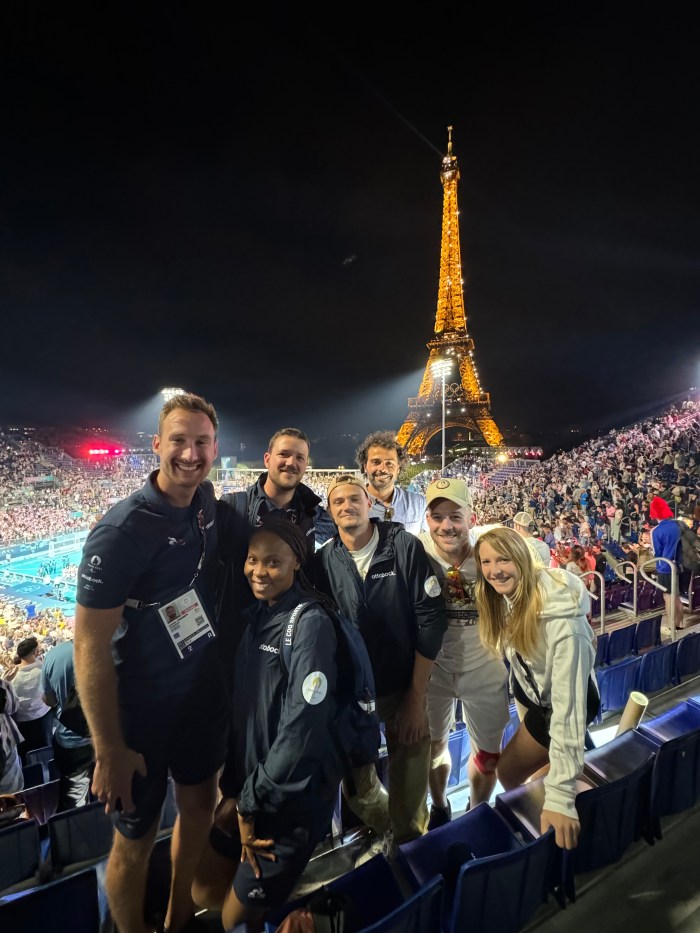
The 27-year-old served as a prosthetist with Ottobock’s global technical support team for the summer 2024 Paralympic Games in Paris. Although they spoke different languages, the technicians’ shared understanding of their craft forged a bond that resulted in successful collaborations. The team repaired more than 3,000 prostheses, orthoses and wheelchairs before and during the Games.
He did not imagine he would be able to accomplish working at the Paralympic Games this early in his career. “It really just means the world to me,” he said. He is a native of Jackson, Michigan.
Prepared with experience
Though it was his first time working at one of the biggest international sporting events, Crisanti was prepared with experience. He fixed the technical devices of para-athletes at the 2023 Parapan American Games in Santiago, Chile. Trained in orthotics and prosthetics, he watched YouTube videos about wheelchair repairs to refine the skills gained at the Parapan American Games.
The 2021 Baylor alum reviewed the fabrication techniques he learned in the program for athletes who needed new, customized sockets connecting their residual limb to the prosthesis. He even packed his personal toolkit, which included new wheelchair tools, to work efficiently.
With close to 55 percent of the technicians’ repairs made on wheelchairs, he spent much of his time in Paris working with the device. He fixed loose, broken, bent and wrongly-adjusted components of the device for para-athletes who competed in intense contact sports, such as wheelchair rugby or wheelchair basketball.
Crisanti said it was rewarding to see the gratitude in the eyes of athletes who did not have spare wheelchairs and depended on the technicians to fix their devices. It’s the same emotion he had on the first day of the Games in Paris, he said. He was grateful to have the opportunity to mount a customized stand to the wheelchair of para-athlete Marcel Hug, which allowed him to carry the Swiss flag during the opening ceremony. Earlier this month, Hug won the wheelchair race of the Chicago Marathon with a time of 1:25:24.
Prosthetics as passion
While Crisanti enjoyed repairing wheelchairs, nothing compared to the fulfillment he had in supporting para-athletes through his passion for prosthetics.
One of his most memorable moments from the Games was adjusting the posterior mount blade of American lower limb prosthetic user Derek Loccident for better stability and performance ahead of the men’s high jump T64 competition. Loccident set a new Paralympic record and won a silver medal in the classification for single below-the-knee amputation.
“It felt really good being able to support him in achieving his goals,” Crisanti said.
His interest in helping those with physical disabilities through orthotic and prosthetic care began in high school. As a junior, he watched an ESPN documentary “Rebekah Strong” about inspirational speaker and amputee Rebekah Gregory. Gregory, a survivor of the 2013 Boston Marathon Bombing and Katy native, lost her left leg below the knee from the domestic terrorist attack.
Courtesy of Lucas Crisanti
Gregory used a prosthetic leg to regain independence and fully return to being a mother. Two years after the bombing, she competed in the same marathon and crossed the finish line where the attack happened. Crisanti said the positive impact the prosthesis had on Gregory’s life inspired him to shadow professionals at an orthotics and prosthetics clinic while still in high school. He felt destined to make this a career.
His dedication to helping people with physical disabilities transcends his career. He engages in several para-sports organizations outside of work. Crisanti serves on the board of directors for the Orthotic and Prosthetic Activities Foundation and previously for the Limb of Dreams Foundation. He volunteers with respected nonprofit organizations, like Ability360, Team Catapult and Arizona Disabled Sports to promote accessible, physical activity for all.
“Sports and exercise are crucial to my physical and mental health,” he said. “Volunteering for parasport organizations gives me the opportunity to help those with physical disabilities get these same (health) benefits.”
Crisanti’s involvement with parasport organizations motivated him to lead the six-month, strategic development of Ottobock Patient Care’s first North American Running Clinic in Phoenix. Amputees trained, practiced and tried on running blades under the supervision of a coach for one day. The event was the first time some of the participants ran since amputation.
Inspired by the success of the Running Clinic, Crisanti took the initiative a step further by co-organizing Ottobock’s first Full Circle Movement mobility clinic in Houston. Amputees learned how to improve their running skills and mobility while learning how to obtain running prostheses through grants since the device typically isn’t covered by insurance.
Despite not being an amputee, Crisanti applied to be a global Running Clinic coach for Ottobock and was accepted. He traveled to Duderstadt, Germany to train under retired para-athlete Heinrich Popow, who earned gold medals at the 2012 and 2016 Paralympic Games. Throughout the training, he learned biomechanical, intercultural and community-building skills.
Courtesy of Lucas Crisanti
Crisanti’s experience as a guide and participant in inclusive marathons also prepared him for coaching. “Being a runner and understanding good form allows me to translate it,” he said.
The networking, mentorship and opportunities Crisanti pursued has paved the way for him to support people with physical differences on their journey to mobility freedom. With every milestone, he raced forward to continue achieving his dream.
“Any dream is obtainable if you’re willing to put in the work,” Crisanti said.
By Jasmine Edmonson, communications associate, Business Operations, in the School of Health Professions at Baylor College of Medicine
 BCM Family