This story was written by Dr. Robia Pautler, professor of integrative physiology at Baylor College of Medicine and member of the College’s Faculty Senate.
Our daughter Emma was born in 2007. She was a beautiful, happy baby who had what others referred to as a “million-dollar smile.” She was smart, sweet and healthy. Our hearts were full. However, when she was 3-years-old, it became clear that her speech skills were not developing as they should.
Initially, we thought it was due to repeated ear infections, but after ear tubes were inserted, her ability to speak did not improve. When Emma was 4, she was diagnosed as being on the autism spectrum. Specifically, she was diagnosed with what was then-called “Pervasive Developmental Disorder Not Otherwise Specified (PDD-NOS).” Typically, the diagnosis is considered to be on the milder side of the spectrum. We were devastated and scared. We thought, “what would her life look like? Could she ever be independent? Will she be OK?” I don’t think I ever cried so hard as I did that day.

Emma and Shazam! show off their ribbons from the American Kennel Club.
We were advised that she would not be successful in a mainstream public school, and that she would likely do better in a smaller, specialized school. We watched our dreams of the first day of kindergarten evaporate… or so we thought.
However, around the same time, a kind speech therapist at Baylor College of Medicine and Texas Children’s Hospital said, “Well, I think she deserves the chance to try.” Those words really struck home, and we agreed. “No matter what, my daughter deserves the chance to try. It’s fine if she’s not successful, but she does deserve the chance to try.” That became our family’s life mantra.
We enrolled her in kindergarten. By the time she entered school, she could read more than 500 sight words; she did well academically. Socially, it was hard for her because her speech was still not as clear as it needed to be for her age. Sensitive to sounds, crowds and heat, Emma struggled when she heard fire alarms, school buses and garbage trucks so much that she would cover her ears and scream. She was on a self-imposed, rigid schedule for waking up, eating meals and going to bed. Kids, however, still were nice to her and she got invited to birthday parties, so she was happy.
The upcoming years were filled with Admission, Review and Dismissal (ARD) committee meetings, Individual Education Programs (IEPs) and accommodations to help her learn. It quickly became clear that neurodivergent kids were not a high priority for some of the administrators and schools, squeezed by shrinking state budgets. However, the teachers almost always went above and beyond to try to help my daughter. I read multiple books on Texas’ laws, as well as federal ones that protect the rights of kids with disabilities. I became very familiar with the Individuals with Disabilities Education Act (IDEA). Some of the battles during these ARD meetings were huge, and it was exhausting to negotiate with her schools for necessary accommodations and resources that were legally due to Emma.
In fifth grade, she stopped talking outside of our home. She was diagnosed with “selective mutism,” which is sometimes seen in people with Autism Spectrum Disorders (ASD). We were ecstatic that a world-leading expert on selective mutism was a Baylor faculty member working in pediatrics at Texas Children’s. Working with this wonderful clinician gave us strategies on how to help Emma talk at school that involve playing a card game and saying the color and number on the card. We were super grateful that so many students, teachers and a service-oriented assistant principal volunteered to help Emma before and after school. These strategies worked, and she started talking more in class. She started hugging her teachers “hello” and “goodbye” after every class, too. We’d personally tutor her every night, and she earned mostly As with a few Bs.
Junior high was rough on many levels as it can be for many children. The friends she had made in middle school became diluted in the crowds in her bigger school. The administration was beyond terrible although many of the teachers were kind and supportive. After calmly stating her legal rights to the principal and staff (once with a lawyer present), we helped get her the support she needed, but it was a battle every time. Being a Baylor College of Medicine faculty member helped me prepare for these meetings because I know how to research a topic with supporting evidence. By graphing out her progress and showing areas of deficits or regression complete with statistical analysis, I was able to succinctly present this information in laypeople terms during ARD meetings.
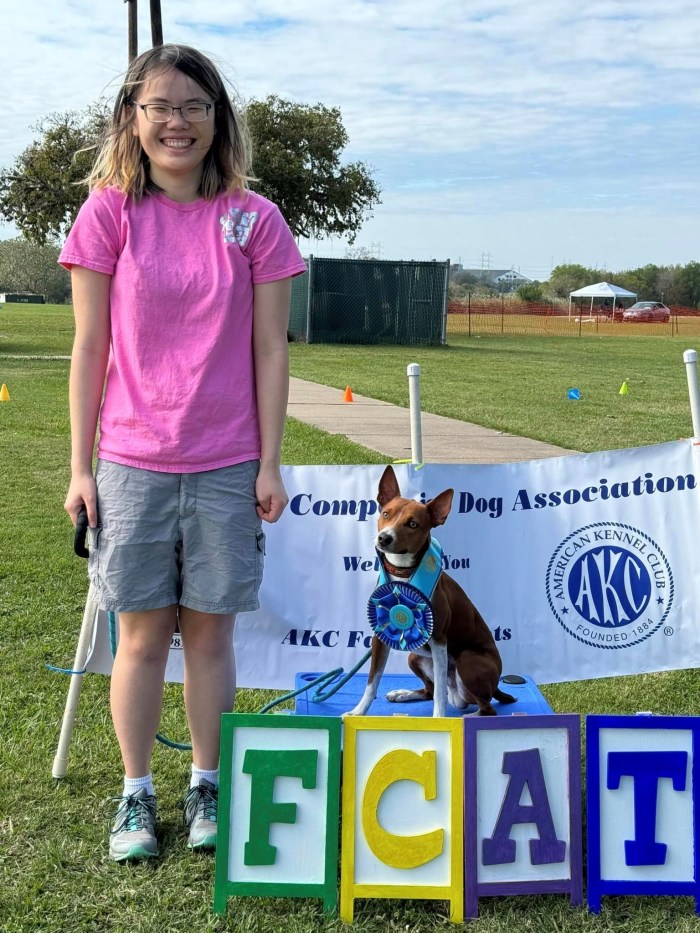
Emma and Shazam! pose during an American Kennel Club Fast CAT competition.
In junior high, Emma found herself no longer being invited to birthday parties. When she gave oral presentations in class, some kids would laugh and make fun of her speech impediment, and she’d come home crying. Eventually, she would go to school and spend time with family on the weekends, but she preferred to stay in her room and just draw. She didn’t like to talk much. Her million-dollar smile faded. The COVID pandemic kept her inside, so she couldn’t learn how to better socialize. When she returned to in-person school, she still earned mostly As with a few Bs. She still hugged her teachers before and after class, but she did not want to talk much outside of the home.
When Emma entered high school, she still didn’t have any friends, but the administration and teachers were all kind and tried their best to work with her. When she was a sophomore, we brought home a little rat terrier puppy from a fabulous woman, Stacy McWilliams. We named the dog Shazam! because of his beautiful red sable fur with white accents. Plus, he was a little firecracker! Emma loved him from the start; she hugged him constantly at home and talked to him, so I began to wonder if maybe there was an activity they could do together to push her out of her room.
I researched and talked to friends in the dog sport community. “Why not try Fast CAT,” they said. Fast CAT is a 100-yard dash where a dog chases a lure tied to a pulley system. The goal is to have the dog run as fast as they can while chasing the lure. It’s a sport sponsored by the American Kennel Club (AKC) with different dog breeds competing on a national level. The Fast CAT team consists of a releaser and a catcher.; the releaser lets the dog go when the Fast CAT “huntsman” shouts “tally-ho!” which signals to the lure operator to start the lure on the track. The catcher catches the dog at the end of the track. There are electronic “eyes” at each end used to record the time it takes the dog to run 100 yards. The releaser is the most important job because if the dog is not released correctly, the dog could run slower. We asked Emma if she wanted to try this with Shazam! After thinking about it, she paused and then said, yes she would.
We signed up for a Fast CAT event in February 2023 right after Shazam! turned a year old. With Emma as the releaser (she deserved the chance to try!), I was the catcher. We were blown away in that first event. For such a young dog, Shazam! was fast. Emma smiled her million-dollar smile and was so excited to be part of the Fast CAT trial. She loved seeing other dogs, all the activity and being outside. After that event, she was thrilled to be given two small ribbons with Shazam!’s times written on them, indicating that he had earned a qualifying score. It was the first time she had won any ribbons.

Emma poses with a T-shirt from the American Kennel Club Fast CAT competition.
Emma was hooked. “Let’s do this again!” she said. So we signed her and Shazam! up for another weekend of Fast CAT, and then another and another after that. They quickly earned not only ribbons from these runs but also rosettes, which signify a new title. Eventually, our daughter and Shazam! reached the highest-level title, the FCAT title (now up to FCAT6) with multiple rosettes adorning her bedroom wall. She also became a registered AKC Junior Handler.
The AKC nationally ranks all the dogs of each breed in Fast CAT each year. The top five ranked dogs of each breed are invited to the AKC Fast CAT Invitationals, an annual national event. We were surprised at how quickly Shazam! and Emma made the top rat terrier category… and even more surprised as our dog waffled back and forth between the No. 1 spot. By the end of December 2023, he had solidified his position as the No. 1 fastest rat terrier in the United States for the entire year. He runs faster than Usain Bolt – not bad for a 22-pound red dog!
Through Fast CAT, we have seen Emma’s confidence soar. Her million-dollar smile is back. She’s talking more at school, and to us. High school is a more supportive environment than junior high was. She delivers oral presentations with pride and even sang karaoke in front of her computer animation class during an end-of-semester party. Her class cheered and applauded wildly for her. She talks to people at Fast CAT, and she loves seeing the dogs. The Fast CAT group knows who she is and many of the people make a point to stop and say hi. She still hugs her teachers “hello” and “goodbye,” and she still earns mostly As with a few Bs. She even jokes around and teases people now. She absolutely loves Shazam! and running Fast CAT with him. She plans on applying to college this year to go into computer animation or pre-nursing with a minor in Spanish. She would also like to teach.
Emma and Shazam! will attend the Fast CAT Invitationals this October. Her school is proud of her accomplishments and has given her permission to miss school to attend the competition. Would she be too upset if she and Shazam! didn’t win the competition? “Nope!,” she said. She’s just there to run Shazam!, have fun and visit with some of the relatives who live in the area. She already has a list of questions that she wants to ask them. After hearing that, I sat back and smiled, knowing she will be just fine.
By Dr. Robia Pautler, professor of integrative physiology at Baylor College of Medicine and member of the College’s Faculty Senate
 BCM Family