BCM Family is spotlighting Dr. Shad Deering, a veteran from the Baylor College of Medicine community, to recognize and honor the contributions of veterans everywhere on Veterans Day.
Baylor College of Medicine has a long history of military connections, from founding president Dr. Michael DeBakey’s military service that led to important healthcare innovations to our commitment to serving veterans through our longtime affiliation with the DeBakey Veterans Affairs Medical Center.
Connections are still being forged through students who go into the service and are recognized each year at Baylor’s Military Commissioning Ceremony, and faculty and staff like Dr. Shad Deering who draw on their military service to contribute to the mission of the College and its affiliates.
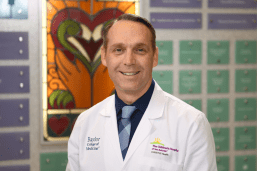
Deering considers himself a mission-driven person, so the military was a strong fit for him. Now, he is bringing that experience and leadership to Baylor and CHRISTUS Children’s, an academic affiliate in San Antonio. He is a board-certified maternal-fetal medicine specialist, serving as a professor at Baylor, associate dean for faculty affairs at CHRISTUS Children’s and system medical director of the CHRISTUS Simulation Institute.
He served in the U.S. Army for 30 years, starting as a 17-year-old cadet at the U.S. Military Academy at West Point and ending with his last military assignment as chair of the Department of OB-GYN at the Uniformed Services University in Bethesda, Maryland.
“A medical career in the military offers a great mission. You get to take care of soldiers – the people who are defending our country – and their family members. It is a very singular focus, from a mission standpoint, it’s very clear,” Deering said.
There is much more to be gained from a medical military career, especially the opportunity for responsibility and leadership earlier in training than many get in a civilian career, he said.
Deering’s journey started right out of high school, when he headed to West Point, not even fully aware of where it was located (New York, by the way). “West Point is very challenging, academically and physically. If you knew what you were getting into, you probably wouldn’t do it but in the end, it is an experience I wouldn’t trade for anything,” he said about his time in the U.S. Military Academy.
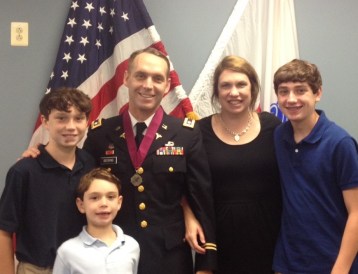
From there, he was one of a small handful of his peers who attended the Uniformed Services University for medical school, followed by residency in obstetrics and gynecology at Walter Reed National Military Medical Center and Bethesda Naval Hospital. Deering then started his fellowship in maternal-fetal medicine at Georgetown University where he created a Division of Medical Simulation, the start of a career-long focus.
“The thing that was different with military medical training than civilian is that you get more responsibility earlier in the military. For example, second-year residents function on their own – they do more and are given more responsibility,” he said. “The same thing happens when you go to your first military staff assignment, and from day one, you may be the department chief at a small hospital.”
Deering’s first career military assignment was at Madigan Army Medical Center in Ft. Lewis, Washington, where he was a maternal-fetal medicine specialist and created a central simulation committee to standardize simulation curriculum for 15 medical specialties across 10 army training hospitals, training over 60,000 providers annually. He then developed the Mobile Obstetrics Emergencies Simulator program that was implemented at more than 50 military hospitals worldwide.
After seven years in that position, Deering volunteered to deploy and served seven months in 2008-’09 in Iraq. He described it as a challenging time – about the midpoint of the war in Iraq when there were still “plenty of air raid sirens.” There, he led the Deployed Combat Casualty Research team, which was responsible for all research done in the combat theater of operations, ensuring IRB protocols were followed, collecting data and conducting inspections and investigations. He called it important work that advanced trauma care both in the military and civilian practice.


He volunteered because that is the ethos instilled in soldiers at the Academy, he said. “When there is a mission and there is something that needs to be done, you volunteer for the hard things.”
Deering ended his military career as a colonel and department chair at Uniformed Services University, having delivered babies in 10 states (plus a combat zone) and earning a Bronze Star for his service. “I loved my career but also liked the idea of doing something different. And, if you are sitting in a military job for a long period of time, you’re sitting in a position that another person could grow into,” he said of his decision to retire. “There is exactly one OB-GYN department chair in the military. It was time to move on and give others the opportunity.”
After only one year in his new civilian role at Baylor and CHRISTUS Children’s (then Children’s Hospital of San Antonio), the pandemic hit, and Deering was asked to serve as the COVID-19 Chief Medical Incident Commander, drawing on his military experience. “It was all about organization and communications and pulling a team together in a changing and stressful environment. That’s where my military training came in to play.”
In San Antonio, he continues to serve the military as there is a large military patient population. He also enjoys attending the Baylor College of Medicine Military Commissioning Ceremony in Houston, where medical students are commissioned into active-duty military positions to continue their medical training.
“When people are looking at ways to do medical school and training, the military pathway offers a fantastic opportunity to grow and mature that you may not get otherwise,” Deering said. “You will be handed responsibility and will grow and learn, not just in medicine but in leadership in general.”
By Dana Benson
 BCM Family