Dr. Mark Kunik has devoted his career to helping elderly adults, particularly those with memory disorders, as a professor in the Menninger Department of Psychiatry and Behavioral Sciences at Baylor College of Medicine.
But it doesn’t stop there – he spends some of his free time working on community outreach through the Alzheimer’s Association Houston & Southeast Texas chapter, and all while breaking some “records” along the way.
Kunik is on his second term as chair for the Walk to End Alzheimer’s Houston, sponsored by the Alzheimer’s Association. Through his involvement with the organization, whether it has been as a chair, board member or walk team leader, he has grown Baylor’s involvement. The College now has one of the largest collections of walk teams in the city. As for fundraising, last year Baylor Memory Walkers ranked No. 1 in Houston.
The Walk to End Alzheimer’s Houston is Nov. 4. If you are a Baylor College of Medicine student, faculty or staff and are interested in starting your own walk team or you would like to join one that is already established, go to act.alz.org/BCM. Currently, Baylor has more than 29 teams with 130 participants.

Walk to End Alzheimer’s Houston in 2016
“I’m a geriatric psychiatrist so I focus on what we can do to improve the lives of older adults. Throughout my career, the Alzheimer’s Association has been a great partner in patient care and caregiver resources,” said Kunik, who is also with the Michael E. DeBakey VA Medical Center. “My involvement with the group came naturally, and I’m happy we have that continued connection that we both can grow from.”
Over the years, Kunik said he has referred patients and caregivers to the Alzheimer’s Association for its programming for people with early-stage illness. He has worked on their speakers’ bureau for community events and for healthcare professionals helping to promote Alzheimer’s awareness and education. Through his involvement as a board member, totaling 12 years cumulatively, he became more involved in the Walk to End Alzheimer’s.
“I started by creating my department walk team, just people I knew or worked closely with. About 10 years ago, I started growing outside of my network, and I teamed up with the Huffington Center on Aging at Baylor and started expanding to other groups within the College,” he said. “Then about four or five years ago, I started to ask other Baylor groups and departments to start their own teams under the umbrella of Baylor College of Medicine.”
The idea was for smaller groups to start their own teams under the title of Baylor, so they each have team leaders and participants they know and work closely with. The hope was to create more community and encourage participation.
In his role as an executive leadership chair for the Houston walk, Kunik works to secure sponsorships, encourage others to create teams and help support fundraising efforts. Last year, Baylor had 25 teams and almost 300 walkers participate.
“Baylor was the top team as far as number of people and number of teams. We are the biggest team in the biggest medical center in the country. Our strong partnership with the Alzheimer’s Association is what I am most proud of because it is not common with other medical schools,” Kunik said.
As the number of members increase, so does the fundraising amounts. More than $92,000 was raised by Baylor teams last year, and since 2012, Baylor walkers have raised more than $460,000. Baylor also is now an official sponsor of the Houston walk. Kunik himself was one of the top 100 fundraisers last year at $38,376, proving that he does more than just “walk the walk.”
Kunik notes that the partnership goes both ways, Baylor has also been on the receiving end of millions of dollars in funding from the association for Alzheimer’s related research and projects over the years. Another great partnership with the Alzheimer’s Association is through the U.S. Pointer study. Baylor is the academic principal investigator and the Houston study site for this trial that looks at how lifestyle changes might protect brain health.
“We are helping the Alzheimer’s Association, and they are helping Baylor. It is a great relationship that provides support for caregivers and to our researchers,” Kunik said. “Part of my research asks the question: Does access to nonprofits provide better care and outcomes for our patients? And we are finding that, yes, there is a benefit. Part of building that partnership is doing this type of work and trying to be an equal partner.”
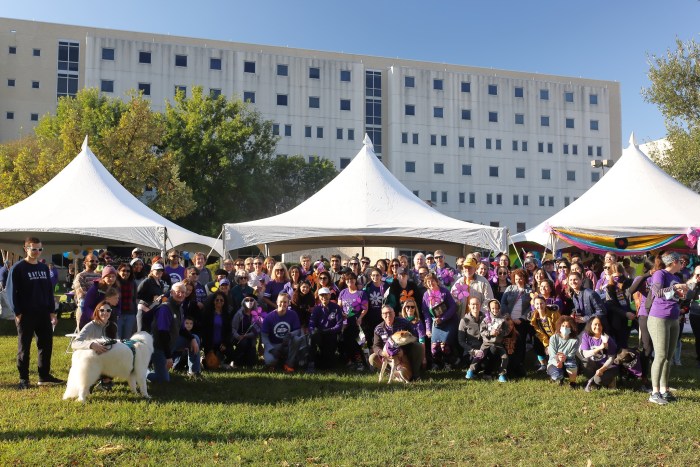
Baylor College of Medicine participates in Walk to End Alzheimer’s Houston.
 BCM Family