Dr. Christopher Wong and Bolatito Adeyeri did not know each other before a group picnic brought them together when both were still students at Baylor College of Medicine.
Hard to believe since they attended the same high school, same university and were accepted as students to the same medical school in the Texas Medical Center. Sometimes, that is the story of Houston, the fourth-largest city in the U.S. with 500,000 residents in the city’s core.
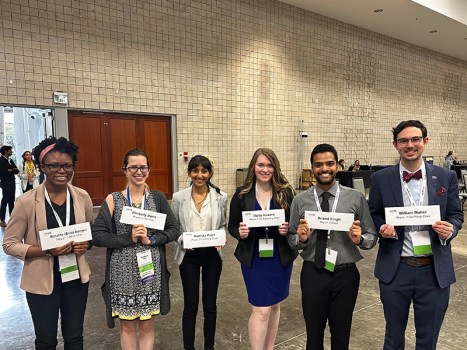
Baylor College of Medicine student Bolatito Adeyeri stays connected through advocacy work.
Wong, a resident in internal medicine and pediatrics and recent graduate of the School of Medicine, and Adeyeri, a third-year medical student and teaching assistant in emergency medicine, attended the Michael E. DeBakey High School for Health Professions (Wong was a senior when Adeyeri was a freshman) before attending the University of Houston for their undergraduate degrees.
Wong is three years older than Adeyeri, and though they had similar ambitions, their paths didn’t cross until attending Baylor as medical students. Now, the two are close friends who work together and apart to make U.S. medical schools and the healthcare industry equitable spaces for all people.
“We met for the first time because we were in the combined Houston Premedical Academy program,” Wong said. “To keep the cohort going, older graduated students met with incoming MS1s to help orient them to medical school. We had a very casual potluck at Miller Outdoor Theater with picnic foods.”
Adeyeri’s interest in advocacy work mirrored Wong’s, and he was thrilled to meet a like-minded future physician who wanted to lay a foundation of advocacy work for future Baylor students to build upon.
During his time as a medical student, Wong participated in several state and national advocacy groups, including the American Medical Association (AMA), Texas Medical Association (TMA) and the Albert Schweitzer Fellowship. Wong received the 2023 Excellence in Public Health Award from the Public Health Service Physician Professional Advisory Committee in May.
During the fellowship, Wong and another fellow developed a health education video series on nutrition, oral health, mental health, COVID-19 and primary care, that was translated into different languages. In addition, they launched a second project to promote elder wellness through virtual discussion groups between health professions students and residents at Houston retirement communities.
Wong’s experiences showed him the multiple hats worn by medical professionals, as well as a responsibility to be a leader with credentials that should be used to better the community.
“A traditional view of physician advocacy may be speaking on compensation or health insurance. While those are important issues, we must also flex our voices in different ways on behalf of our patients,” Wong said. “Getting good coverage and access to other services like mental health, nutrition and therapeutic support will overall benefit our communities and public health.”
While an undergraduate at UH, Adeyeri began to understand how social determinants of health affected the lives of everyday people, more specifically how healthcare professionals could work to improve them outside of the clinic. She studied the Supplemental Nutritional Assistance Program (SNAP) and wrote a research paper for a policy course on how to increase its funding.

Dr. Christopher Wong stayed connected in medical school through advocacy work, including working with the American Medical Association.
Last year, she was selected as the Region 3 Diversity, Equity, Inclusion and Accessibility Chair for the American Medical Association. She is also a member of the AMA Medical Student Section House of Delegates Coordination Committee.
Adeyeri supported other students with similar SNAP funding ideas to create policies for increasing funding and expanding eligibility during her time working with the AMA. During her first and second year, she reviewed and gave feedback on several policies.
Moving forward in medical school, Adeyeri wants to help her peers get involved in the AMA by asking them to describe what they see on rotations or urging them to seek out committees who want a medical student perspective.
“Medical school is a cool time for a number of reasons. There are a lot of things we won’t be able to do when we become full-time doctors,” she said.
Last fall, she helped write policy for the TMA, including policies improving medical education of trauma-informed care and correctional health for incarcerated patients.
“The driving force behind the resolution is increased educational opportunities for students to shadow and have rotations in correctional facilities and interacting with those patients more,” Adeyeri said. “Medical students are more likely to care for that population if they have the experience of caring for them in medical school.”
Starting in July, Adeyeri started as a member of the National Resident Matching Program (NRMP) Board of Directors, along with 19 others. The NRMP uses a mathematical algorithm to place applicants into residency and fellowship positions.
Both Wong and Adeyeri are grateful to the deans and administrators at Baylor who have signed off and advised them in various positions in Texas and nationwide. Dr. Edward Lee Poythress, associate dean in the Office of Student Affairs and associate professor of internal medicine, acted as faculty adviser for Wong’s fellowship.
Poythress called Wong “truly tireless in his pursuit to improve the lives of his fellow citizens.”
Adeyeri, who serves as student president of the TMA-AMA chapter for Baylor, said she’s happy for the support from her professors and deans, as well as the protected time to dedicate to advocacy work.
“Advocacy is a really good way for me to feel empowered to do something about the issues of public health, medical practice and medical service,” Wong said. “Advocacy is preventive.”
By Julie Garcia


 BCM Family