For some healthcare professionals, the COVID-19 pandemic was a decisive moment in medical history. Burnout and stress ran parallel to an increased interest in public health and safety, causing rifts in an industry that resulted in healthcare workers either taking their career exits or starting jobs in a time of crisis.
For others, the pandemic was a call to action.
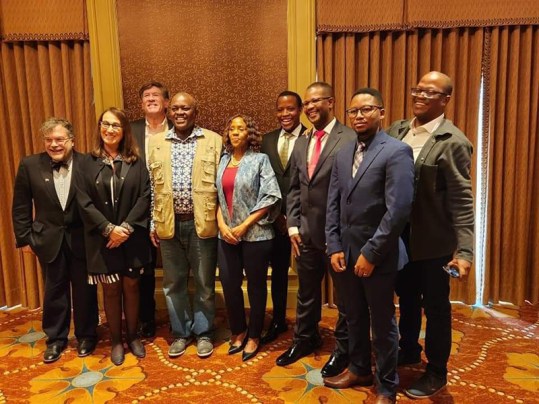
Dr. Peter Hotez, dean for the National School of Tropical Medicine at Baylor College of Medicine; Dr. Maria Elena Bottazzi, associate dean for the National School of Tropical Medicine; Michael Mizwa, chief executive officer of the Baylor International Pediatric AIDS Initiative; President of the Republic of Botswana, His Excellency Dr. Mokgweetsi E.K. Masisi; First Lady of the Republic of Botswana, Her Excellency Neo Masisi; Tshepiso Kago; Tshepiso Eric Chelane; Gaone Matlhare; and Dr. Mogomotsi Matshaba, executive director of the Botswana-Baylor Children’s Clinical Centre of Excellence Trust.
“We experienced a lot of casualties due to COVID in Botswana, and there are still more diseases that need attention to prevent deaths,” said Tshepiso Chelane, a chemist at the Botswana National Food Quality Control Laboratory. “I want to see Botswana as one of the healthiest countries in the near future. For me to study vaccine development at Baylor would make that possible.”
Chelane is one of three scientists from Botswana who were selected for a fellowship with the Texas Children’s Hospital Center for Vaccine Development at Baylor College of Medicine, along with Tshepiso Kago, a senior laboratory scientist at Nyangabgwe Hospital in Francistown, Botswana, and Gaone Matlhare, a regulatory officer at the Botswana Medicines Regulatory Authority. Under the leadership of Drs. Maria Elena Bottazzi and Peter J. Hotez, the three will be trained in early to mid-stage vaccine development to help the country advance its capacity for the development of biologics in the public and private sectors.
The agreement signed between the parties outlines a year-long curriculum that includes all steps of vaccine development: antigen discovery, molecular biology, formulation and more. The Center will train nine Botswana-selected scientists over three years, with this cohort being the first. When the agreement is complete, the Center will continue to mentor the nine scientists to ensure they are independent experts in the field of vaccine development.
Chelane, Kago and Malthare arrived in the U.S. in November 2022 and began their work under the supervision of Dr. Ulrich Strych, associate professor of Pediatric Tropical Medicine and director for Strategic Initiatives and Program Development at the Center for Vaccine Development. Strych serves as the Faculty Mentor for these fellows’ work and also coordinates
With each partnership, coursework guidelines are defined in official documents. But understanding how to best guide the fellows through the program takes more effort than what is in print.
“These collaboration projects start long before the fellows arrive. We try to determine what their interests are, and what they want to get from this experience. These are not students, they come with education and training, and we adapt to that,” Strych said. “We always say we want them to become the trainer of trainees. We want our fellows to take the lessons and techniques learned here and teach them to others, not just go back to the positions that they had before they came.”
Strych believes the Center is one of the most unique places to receive a hands-on experience that trainees will not have anywhere else; pharmaceutical companies like Pfizer or Moderna do not typically invite international students “to look behind the curtains and see how they make the vaccines and how they prepare for regulatory approval of the vaccines,” he said.
More than six months have passed since the fellows arrived, and they are absorbing the material with exuberance. Chelane’s interest is in the quality control portion of the vaccine development process and what he has learned so far has allowed him to expand on techniques he already uses in Botswana and has given him ideas on how to implement changes when he returns there. Matlhare has been impressed with the ease of access that institutions have to data from the U.S. Food and Drug Administration and plans to recommend a similar system in Botswana. Kago is excited to learn about the product clarification process in vaccine development, which is the portion of the curriculum he’s currently studying.
Adjusting to a new country can be a challenge for anyone, especially when home is more than 19 hours away by plane. The trio has left behind family and commitments, putting life plans on pause to pursue this fellowship.
“We are learning quite a lot of information that I am excited to take back,” Matlhare said. “But outside of the lab, the city of Houston is different from Gaborone.”
The cohort is coping with the distance in uniquely Houston ways. From catching Rockets games to immersing themselves in the cultural exchange at Texas Children’s, to visiting Miller Outdoor Theatre for a summer orchestra concert and attending WWE matches, each fellow has found a way to make the most of their time during the duration of their time in the Bayou City.
However, all three wake up extra early or defer a little sleep to call their loved ones back in Botswana.
“Obviously, I miss home. I miss my parents. I miss my family. But one of the messages we were given when we left was, ‘When you are there, you three are family. You know what to do,’” Kago said. “The rest will be history.”
By Aaron Nieto
Tshepiso Kago, Tshepiso Chelane and Gaone Matlhare would like to extend their gratitude to Michael Mizwa, CEO of Baylor College of Medicine’s International Pediatric AIDS Initiative at Texas Children’s Hospital (BIPAI), director of Texas Children’s Global Health and chair of the Botswana-Baylor Trust, for mentoring and guiding them during their visit to the U.S. Additionally, Dr. Ulrich Strych wishes to extend his gratitude to Mizwa, the Botswana government, Baylor Global Health, the International Student Office and the support staff at each institution involved for their work on bringing citizens from around the world to study and train at Baylor.
 BCM Family