The first exercise at the Alan Alda Center for Communicating Science workshop for Baylor College of Medicine faculty and staff sounded as easy as 1-2-3.
Everyone in the room was partnered up and instructed to count to 3 as fast as they could, alternating numbers with their partners. Each round added a new level of difficulty, such as replacing the number 2 by stomping your foot, and so on. As the task became more difficult, more participants became tongue-tied and made mistakes. Every time someone messed up, both partners had to throw their hands up in the air and yell “ta-da!” Soon, everyone in the room was laughing and yelling “ta-da!”
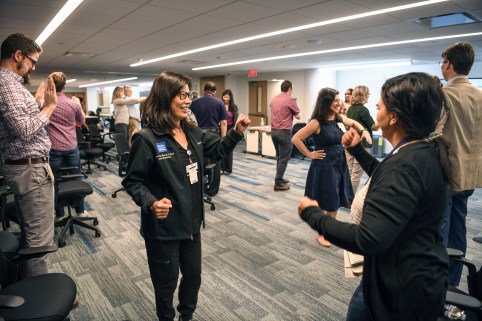
Baylor College of Medicine faculty participated in an improv skills communication workshop hosted by the Alan Alda Center for Communicating Science in April 2023.
The exercise is designed to introduce participants to two main ideas of improvisational theater: “Yes, and,” and making your partner look good. To be successful, two partners have to support each other and move the scene forward. When one person makes a mistake, both acknowledge the mistake in a silly way and move on. Both partners are in it together.
The lesson is one of many developed by the Alan Alda Center for Communicating Science at Stony Brook University as a way to teach physicians and scientists improvisation techniques so they can be better communicators. Dr. Kasey Davis, assistant professor of pediatrics – critical care at Baylor, participated in an Alda Center conference in 2018 with actor Alan Alda. When Baylor’s School of Medicine leadership expressed interest in providing faculty training in applied improvisation so they may apply those skills to the advanced communications curriculum for future medical students, Davis immediately suggested bringing the center’s team to Baylor.
“I knew that Baylor faculty would experience a world-class introduction to the use of improvisational theater techniques to promote effective communication,” Davis said. “Improvisational exercises encourage connection and collaboration amongst performers. These exercises can be easily adapted for medical education to promote active listening, mental presence and effective teamwork – all necessary skills for successful clinical performance.”
During the workshop held at the Texas Medical Center Library in April, faculty participated in a series of improvisation exercises that helped them learn effective communication that emphasized listening to the audience and reacting with empathy. An exercise that required one partner to mirror the motions of their partner demonstrated how the leader could help their follower succeed. An activity called hobby speed dating called for one partner to question the other about a hobby, then explain their own scientific research using their partner’s hobby as a metaphor. After several rounds with different partners, participants learned to apply different communication strategies to make complex topics more relatable to their audience.
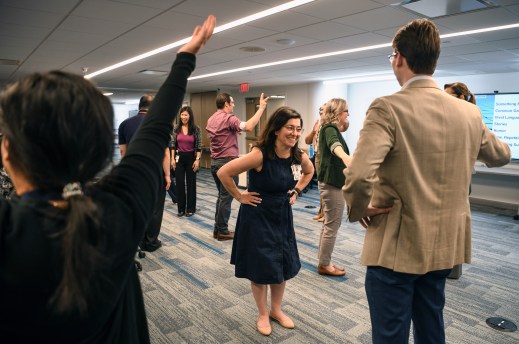
Baylor College of Medicine faculty participated in an improv skills communication workshop hosted by the Alan Alda Center for Communicating Science in April 2023.
Other exercises also taught participants how to connect with their audience and use communication techniques like repetition, storytelling and humor. Throughout the afternoon, participants focused on incorporating the improv principle “yes, and,” which means accepting what your audience offers and building on the idea in a productive way, into their communications.
“Our goal with this improv workshop was to teach attendees how to communicate more effectively with their audience, whether it’s a classroom full of students or a patient in the clinic,” said Dr. Alison Haddock, one of the event organizers and assistant professor of emergency medicine and of education, innovation and technology at Baylor. “Faculty members who attended the workshop had great things to say about the experience. Even some who were initially reluctant saw the value of the exercises once they had the opportunity to participate in them. Now they’ll be able to take what they learned and apply it to both their patients and their teaching in the renewed medical school curriculum.”
The School of Medicine leadership plans to incorporate the communication strategies that faculty learned during the workshop into a new curriculum for medical students which will start in the new academic year. Curriculum will focus on active learning with more student engagement.
“We are excited to utilize improvisation techniques to create an innovative and impactful advanced communication curriculum,” said Dr. Nadia Ismail, vice dean of the School of Medicine and professor of medicine and of education, innovation and technology at Baylor. “We also had our colleagues from Baylor’s new Temple campus join us and had a great time getting to know each other while learning improv.”
By Molly Chiu


 BCM Family